"The only ether which has survived is that which was invented by Huygens to explain the propagation of light."
Maxwell, James Clerk (1878), "Ether", Encyclopaedia Britannica, vol. 8 (9th ed.), pp. 568–572
First we need to define and understand waves, which are flows or transfers of energy in the form of oscillations or vibrations. There are three types of waves: mechanical, electromagnetic, and matter. We won't be discussing matter waves since they are theoretical and presume that something can exist as both a particle and a wave. Nothing can be a wave, because a wave is a reaction to a disturbance.
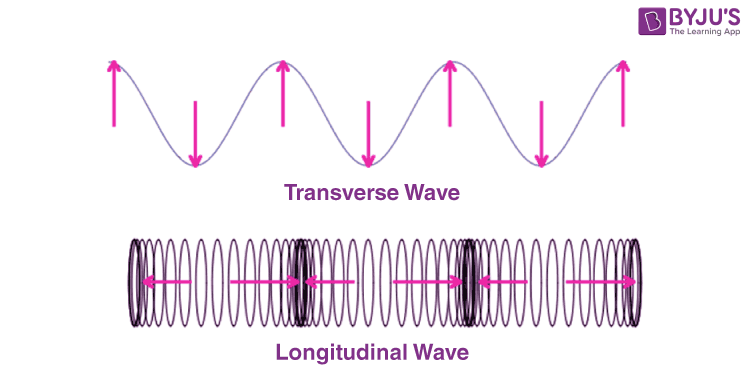
Mechanical waves (e.g. sound, water, seismic) happen when matter reacts to a disturbance by transferring energy. This reaction manifests as matter displacement in regular patterns until the energy is dissipated. These reactions have an amplitude (height, volume, or intensity) and a frequency (speed of cycle repetition). There are two types of mechanical waves: transverse and longitudinal. Water waves have both properties, but not every material does.
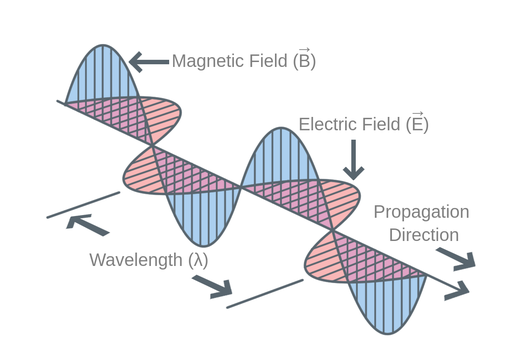
Electromagnetic (EM) waves are defined in physics as non-mechanical waves (requiring no medium), since they can travel through a vacuum and many solid materials. Examples include light, x-rays, radio waves, and microwaves.
Yet nothingness cannot oscillate, so what's actually waving in a vacuum? This article states that "the vacuum [of space] isn't some state of nothingness, it's a polarizable medium… So, what waves when a light wave moves through space? There can only be one answer, and that answer must be space." Yet it just said that light travels in waves, so which is it? What's waving, light or "the vacuum of space"? And what about the cause of the wave, the disturbance of the medium? Is it the creation of an EM field? If space is what waves, then anything disturbing it would have the same effect, since space would wave according to its own properties, not those of the disturbing force. In fact, if EM waves are non-mechanical, then trying to explain them in terms of mechanical waves is self-defeating. On the other hand, thinking of them as combinations of mechanical waves allows us to engineer working products.
Just as nothingness can't oscillate, we're also told that photons* (units or quanta of light) never oscillate. So how can there be frequency (a repeating pattern) without oscillation? The "frequency" of light would have to be the number of photons over time, but this wouldn't explain the repeating cycles we detect in EM radiation. Photons would explain the photoelectric effect, but where is the frequency coming from? According to this article (ignore comments that appeal to the fictional entity "spacetime"), a photon does not have wavelength. Rather, it has a wave function, which is a probability distribution as demonstrated by the double-slit apparatus. The key to understanding EM waves can be explained as follows:
The mistake which led to the hypothesis of the ether was that wave motions were the only waves known at the time when the wave theory of light was proposed, and so the light wave was also considered as a wave motion and the question asked, "What moves in the light wave?" And this moving thing was called ether. Since that time, we have become familiar with waves which are not wave motions, but merely periodic phenomena. Thus the alternating current is a wave, but nothing moves in it. Thus we speak of waves of temperature etc, without meaning any material motion. The radio waves and light waves are electromagnetic waves, that is, periodic variations of the electromagnetic field in space.
Suppose you're driving on the highway and keep the pressure on the gas pedal constant. Then you come to a steep incline and your speed decreases, but the rate of gas you're feeding the engine stays the same. When you reach level ground again, your speed returns to what it was before. So the amount of energy stays constant, but the speed varies according to environmental conditions.
From this article, we can see that light "filtering" has more to do with its angle than its nature (quanta or waves), which determines how much of the light reaches the detector.
We should not invent undetectable things like "ether" or "spacetime" just to solve a problem (or, really, to move the goalposts farther away). We must stick to empirical science and acknowledge its limitations, and also admit that we really don't have the capacity to fully grasp God's creation. EM energy and its manifestations seem to be fundamental to the nature of our realm, like natural laws such as entropy.
* From this video: In a nutshell, [photons are obtained] by lowering the intensity of a light source to the point of zero emitted by the source and then slowly increasing it. We might understand how a photon can be "split" in the same way a magnet can be split but result in two smaller bipolar magnets instead of two unipolar magnets (an impossibility). So splitting a photon would result in two photons with half the original energy each, but all the same "spin" (direction of magnetic field).